How to order food in Japanese
Travel to Japan through its food and learn how to enter a restaurant, choose a dish, order politely, and ask for the bill.
For many travellers, food is one of the best reasons to visit Japan. A bowl of ramen at a tiny counter, fresh sushi near a market, or hot okonomiyaki cooked in front of you can become the memory you keep from the whole trip.
You do not need advanced Japanese to enjoy those moments. A small set of phrases can take you from the restaurant door to the end of the meal.
By the end of this lesson, you will know what to do when you enter, how to order by pointing or naming a dish, how to ask for a recommendation, and how to request the bill.
When you enter
The staff may greet you with いらっしゃいませ (irasshaimase).
This phrase is directed at the customer. You do not need to answer it. A smile or a small nod is enough.
The staff may ask 何名様ですか (nanmei sama desu ka), “How many people?” You can answer 一人です (hitori desu) for one person or 二人です (futari desu) for two.
Order by pointing
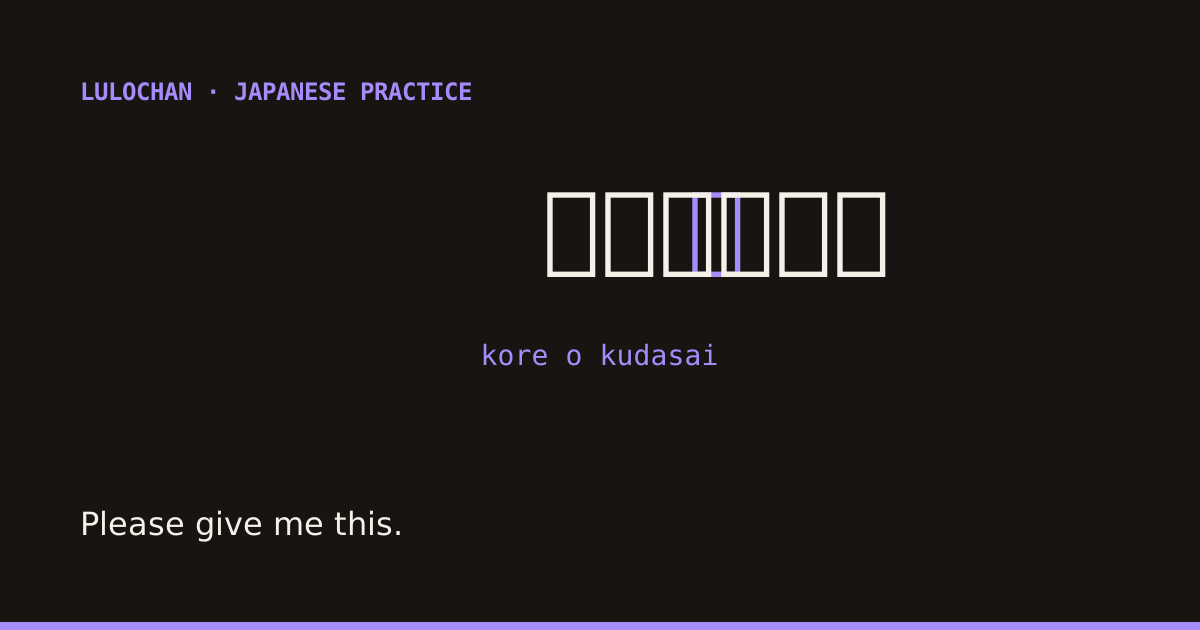
When you can see the dish on a menu or in a display, the most useful phrase is これをください (kore o kudasai).
これ (kore) means this. を (o) marks the thing you want. If you want to understand why it follows the dish, read the lesson about を (o) and the object of an action. ください (kudasai) means please give me.
The structure is thing + を (o) + ください (kudasai). Japanese puts the requested item first.
Choose the particle that connects the item with the request:
Loading exercise…
Order a dish by name
If you know the dish, replace これ (kore) with its name.
You can use the same pattern for dishes you may want to try during your trip:
You do not need to add “I want”. The dish plus ください (kudasai) already forms a clear and polite request.
Now arrange a complete ramen order:
Loading exercise…
A natural alternative
At restaurants, you will also hear お願いします (onegaishimasu) after the item.
Both versions are polite. ください (kudasai) focuses on asking to receive the item. お願いします (onegaishimasu) is a broader polite request and often sounds natural when placing an order. As a beginner, you can use either one safely.
Ask what the restaurant recommends
Sometimes the best dish is the one you did not plan to order. Ask おすすめは何ですか (osusume wa nan desu ka).
The answer may contain unfamiliar words. That is fine. Look at what the staff points to, repeat the dish name, and finish with お願いします (onegaishimasu).
Ask for water
In many Japanese restaurants, water or tea is provided without asking. When you do need water, say:
The polite お水 (omizu) is more natural in a restaurant than the plain 水 (mizu).
Ask for the bill
When you finish, say お会計お願いします (okaikei onegaishimasu).
In Japan, you often take the bill to a register near the exit instead of paying at the table. Watch what other customers do if you are unsure.
Your restaurant scene
Picture a restaurant you want to visit in Japan. You enter, hear いらっしゃいませ (irasshaimase), sit down, point to a dish and say これをください (kore o kudasai). After eating, you ask for the bill with お会計お願いします (okaikei onegaishimasu).
Practice that short scene aloud with a real Japanese dish you want to try. The goal is not only to know the words, but to imagine yourself using them when the food finally arrives.
Ready to practice ordering food?
Practice a useful restaurant phrase with an AI tutor.
Practice ordering food