How to introduce yourself in Japanese
Learn a natural Japanese self introduction with your name, where you are from, and the right opening and closing phrases.
Meeting someone for the first time is one of the easiest situations to prepare for in Japanese. A basic introduction follows a predictable order, so you do not need to invent a new sentence every time.
By the end of this lesson, you will be able to greet someone for the first time, say your name, optionally add where you are from or what you do, and close naturally.
Open the introduction
Start with はじめまして (hajimemashite). You use it only when meeting someone for the first time.
English often uses “nice to meet you” at the end of an introduction. Japanese divides that job between an opening and a closing phrase. はじめまして (hajimemashite) opens the exchange and tells the listener that this is your first meeting.
Do not use it every time you see the person. On your second meeting, a normal greeting is enough.
Say your name
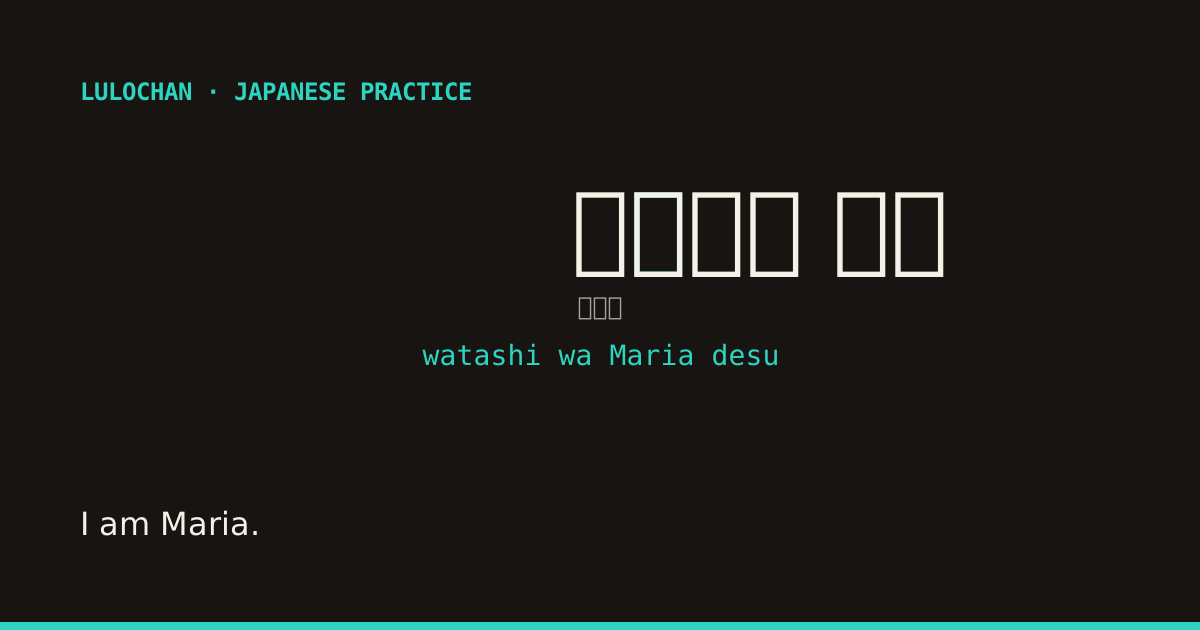
The complete beginner pattern is 私は name です (watashi wa name desu).
私 (watashi) means “I”. は (wa) marks you as the topic. If that function is new to you, the lesson about は (wa) explains how Japanese establishes a topic. Your name follows, and です (desu) gives the sentence a polite ending.
Choose the particle that completes the name pattern:
Loading exercise…
In a real conversation, Japanese speakers often leave out 私 (watashi) because it is already obvious who is speaking. That gives you a shorter and very natural version:
Both versions are correct. Use the full pattern while learning. As it becomes comfortable, you can use the shorter one.
Now put the complete sentence in Japanese order:
Loading exercise…
Do not add さん (san) to your own name
さん (san) is a polite title used after another person's name, similar to Mr or Ms but much more common.
You may call the other person マリアさん (Maria san). You should not introduce yourself as マリアさん (Maria san), because that would attach an honorific title to your own name.
This distinction matters because English speakers sometimes hear names with さん (san) and assume it belongs to the name. It does not. It shows respect toward the person being addressed.
Add where you are from
Once your name is clear, you can add your country. から来ました (kara kimashita) means “I came from”, and in an introduction it works like “I am from”.
Replace メキシコ (Mekishiko) with your country. For example, スペイン (Supein) means Spain and アメリカ (Amerika) means the United States.
You do not need to add this sentence if the situation is brief. Your name alone is already a complete introduction.
Add what you do
If it is relevant, you can say your role using 私は role です (watashi wa role desu), the same structure as your name.
学生 (gakusei) means student. 会社員 (kaishain) means company employee. To understand why these descriptions end this way, continue with the difference between です (desu) and ます (masu). Only add information that belongs in the conversation. A natural introduction is not a list of every fact about you.
Close naturally
Finish with よろしくお願いします (yoroshiku onegaishimasu).
There is no perfect one line English translation. In this situation, it expresses goodwill toward the relationship you are beginning. “Nice to meet you” is a useful translation, but the Japanese phrase carries the feeling of “I hope we get along well”.
Your complete first introduction
Put the pieces together in this order:
You do not need to memorize everything at once. Begin with the opening, your name, and the closing. Add your country or role only after those three pieces feel easy.
Say your introduction now using your real name. That turns this pattern from something you recognize into something you can actually use.
Ready to practice your introduction?
Say your first Japanese sentences with an AI tutor.
Practice your introduction