です (desu) and ます (masu) in Japanese
Learn when a description ends with です (desu), when to use a verb in ます (masu), and why the two endings do not combine.
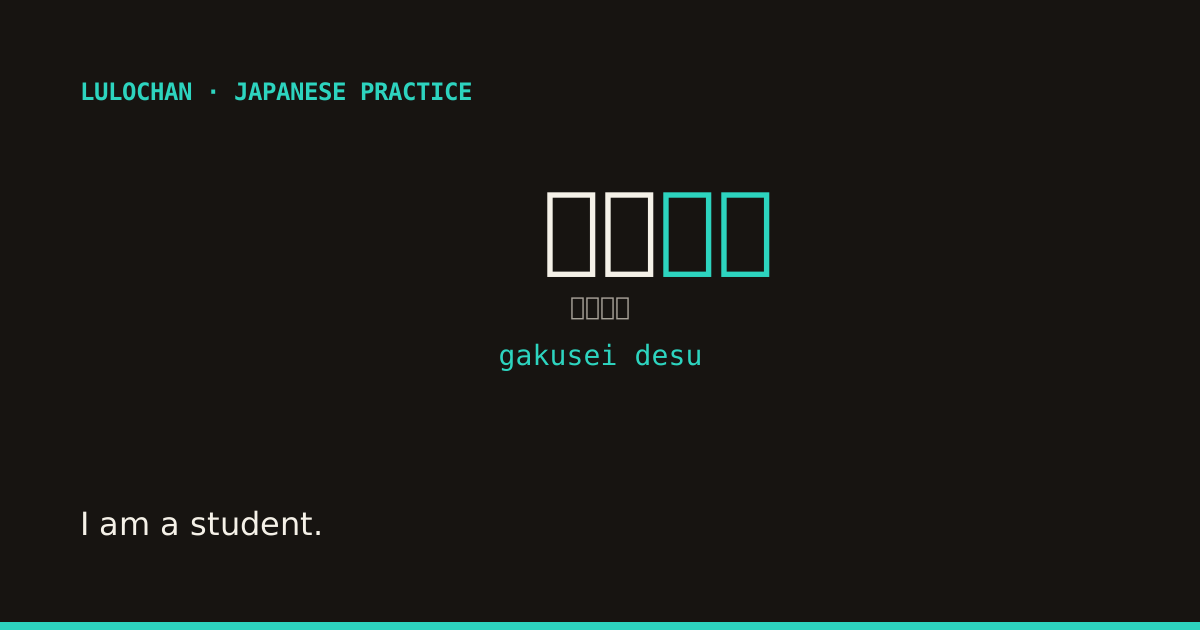
Your first Japanese sentences will often end in one of two ways. Some close with です (desu). Others contain a verb ending in ます (masu).
They may look like interchangeable ways to sound polite, but they are not. The choice depends on the kind of information you want to communicate.
By the end of this lesson, you will be able to look at an idea and decide whether it describes what something is or tells what someone does. That decision tells you whether you need です (desu) or a verb in ます (masu).
Two paths for closing a sentence
Use です (desu) after a noun or certain kinds of description. Use a verb ending in ます (masu) when you express an action politely.
The first sentence answers “What are you?” The second answers “What do you do?”
です (desu) for identities
After a noun, です (desu) presents an identity, profession, nationality, or category politely.
In these sentences, です (desu) resembles forms of “be”. It is still better not to memorize it as an exact translation of the English verb. Its main job here is to close a noun description politely. You can see it inside a complete conversation in the lesson about introducing yourself in Japanese.
です (desu) for descriptions
です (desu) also follows words that describe qualities.
静か (shizuka) means quiet. It is not an action. It describes the place, so the sentence ends in です (desu).
You may also hear おいしいです (oishii desu), it is delicious. Here です (desu) adds politeness to the description.
ます (masu) belongs to the verb
ます (masu) is not freely attached to any word at the end of a sentence. It is part of the polite form of a verb.
The actions are eating, working, and reading. Each verb already contains its polite ending.
Do not add です (desu) after ます (masu)
A sentence takes one path or the other.
学生です (gakusei desu) is correct because 学生 (gakusei), student, is a noun.
食べます (tabemasu) is correct because it is already a polite verb.
食べますです (tabemasu desu) is incorrect. It adds two polite endings where only one is needed.
Decide from the question
When you are unsure, ask yourself one of these questions:
| Kind of information | Mental question | Usual ending |
|---|---|---|
| Identity or category | What is it? | です (desu) |
| Quality or state | What is it like? | です (desu) |
| Action | What does someone do? | verb in ます (masu) |
Select the two sentences that use their endings correctly:
Loading exercise…
Why the u can be hard to hear
In natural speech, the final vowel in です (desu) and ます (masu) is often very weak. です (desu) can sound close to “des”, and ます (masu) close to “mas”.
You do not need to force this reduction immediately. Pronouncing a soft u is correct and understandable. Your ear will become familiar with the natural rhythm over time.
Describe and act
Imagine two columns about yourself. Put three identities or descriptions in the first: student, teacher, quiet, busy. Put three actions in the second: study, work, read.
End the ideas in the first column with です (desu) and turn the actions in the second into verbs with ます (masu). This makes the difference a decision about meaning rather than two endings learned by memory.
Ready to practice polite Japanese?
Say simple sentences with an AI tutor that talks back.
Practice polite Japanese