The Japanese particle に (ni)
Learn how に (ni) points to a specific place, time, or recipient of an action.
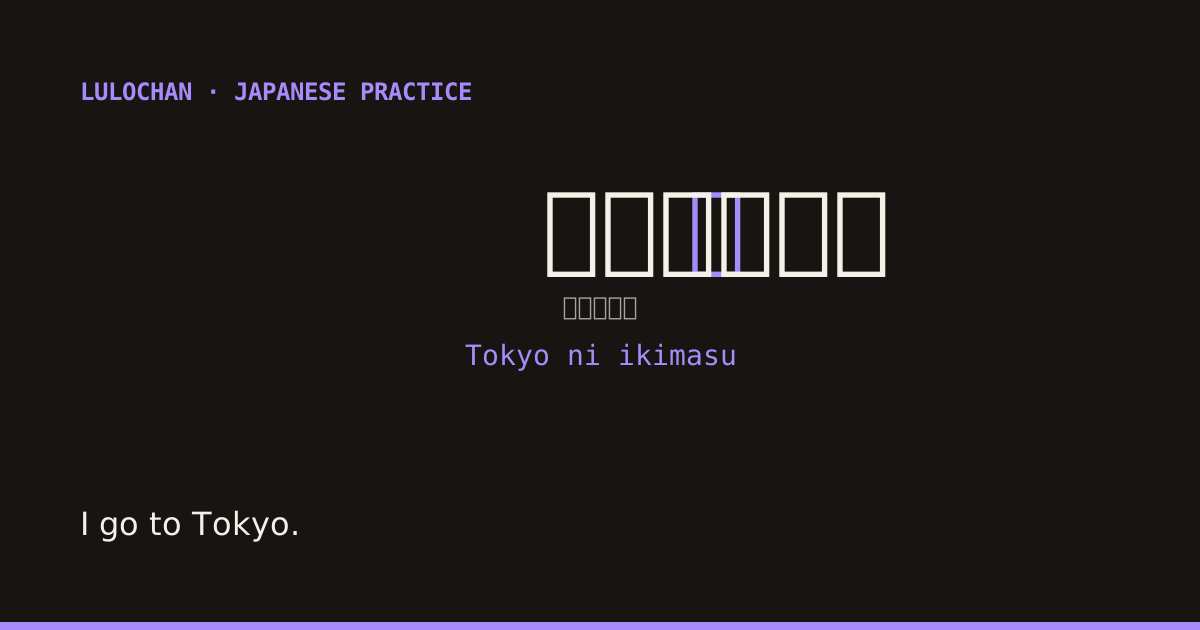
Think about an ordinary day. You wake up at a specific time, go to class, and hand an assignment to your teacher. These actions are different, but each one points toward something: a time, a destination, or a person.
The particle に (ni) marks that point.
By the end of this lesson, you will be able to use に (ni) with destinations and specific times, recognize the person an action moves toward, and distinguish に (ni) from で (de).
An arrow pointing to a point
A useful way to understand に (ni) is to imagine an arrow. The arrow can point toward a place, a time, or a person.
A destination
With movement verbs, に (ni) marks the point where you arrive.
学校 (gakkou), school, is the destination. 行きます (ikimasu) means go.
The same pattern works with 来ます (kimasu), come, and 帰ります (kaerimasu), return.
Choose the particle that marks the destination:
Loading exercise…
A specific time
に (ni) also marks the exact point when an action happens.
七時 (shichiji), seven o'clock, is a precise point in time. The action of waking up happens at that point.
Not every time expression takes に (ni). Relative words such as 今日 (kyou), today, 明日 (ashita), tomorrow, and 毎日 (mainichi), every day, normally appear without it.
The difference is simple: a clock time behaves like a point. “Today” and “every day” already locate the action without に (ni).
The person who receives something
The arrow of に (ni) can also point toward a person.
先生 (sensei), teacher, is the point toward which the homework moves. 宿題 (shukudai), homework, is the thing being handed over, so it takes を (o). The lesson about を (o) develops that second role.
に (ni) and で (de) do different jobs
This distinction confuses many beginners because both particles can follow a place.
In the first sentence, the library is a destination and takes に (ni). In the second, it is the setting where studying happens and takes で (de). To practice this contrast further, continue with the lesson about で (de).
Select the sentences where に (ni) correctly marks a point:
Loading exercise…
Organize a day with に (ni)
Think of one destination and one specific time for tomorrow. Make two sentences: “I go to X” with X に行きます (X ni ikimasu) and “I do something at X” with time + に (ni).
If you can picture an arrow ending at a point, you already have the most useful mental model for recognizing に (ni).
Ready to practice に (ni)?
Practice destinations with an AI tutor that talks back.
Practice に (ni)