How to ask where something is in Japanese
Learn how to ask where a station, restaurant, toilet, or other place is in Japanese, and understand the answer you receive.
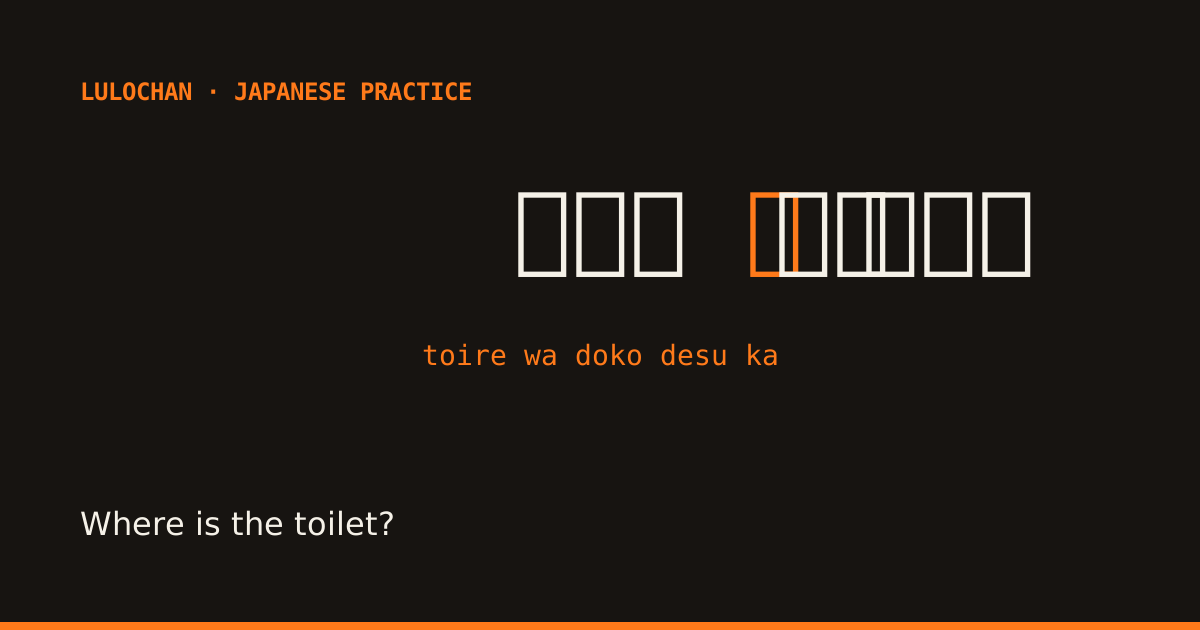
Imagine that you have just arrived in Japan. You leave the station, your phone has little battery, and you need to find a restaurant you saved for the trip. One question can help you find almost any place.
By the end of this lesson, you will know how to ask where something is, get a stranger's attention politely, replace the place in the question, and recognize a few words in the answer.
The question you can reuse
The pattern is place + は (wa) + どこ (doko) + ですか (desu ka).
どこ (doko) means “where”. は (wa) marks the place as the topic. That job is explained step by step in the lesson about は (wa). ですか (desu ka) turns the sentence into a polite question.
Japanese puts the place first. Instead of following the English order “where is the toilet”, think “as for the toilet, where is it?”
Choose the particle that marks the place you are asking about:
Loading exercise…
Change the place
Once you know the pattern, only the first word changes. 駅 (eki) means station.
If food is one of the reasons you travelled to Japan, レストラン (resutoran) will be useful.
For a specific restaurant, replace レストラン (resutoran) with its name. The rest of the sentence stays exactly the same. Once you find it, the guide to ordering food in Japanese helps you continue the experience.
Ask before the question
Do not begin speaking to a stranger without getting their attention. Start with すみません (sumimasen), which means “excuse me” here.
すみません (sumimasen) is useful in stations, shops, hotels, and restaurants. Say it, wait until the person looks at you, and then ask your question.
Now build the complete question in Japanese order:
Loading exercise…
What might the answer sound like?
You do not need to understand every word. Listen for a direction and watch the person's gesture.
ここ (koko) means here. そこ (soko) means there, near the listener. あそこ (asoko) means over there, farther from both speakers.
You may also hear 右 (migi), right, or 左 (hidari), left.
If the answer is too fast, showing the place name on your phone and following the gesture is completely normal.
Close the exchange
After someone helps you, say ありがとうございます (arigatou gozaimasu), thank you very much.
The whole exchange can be only two lines: すみません (sumimasen) plus your question, followed by ありがとうございます (arigatou gozaimasu).
Use it on your trip
Choose one place you genuinely want to visit in Japan, perhaps a ramen shop, a market, or a train station. Put its name before はどこですか (wa doko desu ka) and say the complete question aloud.
Ready to practice asking where?
Practice a real question with an AI tutor.
Practice directions